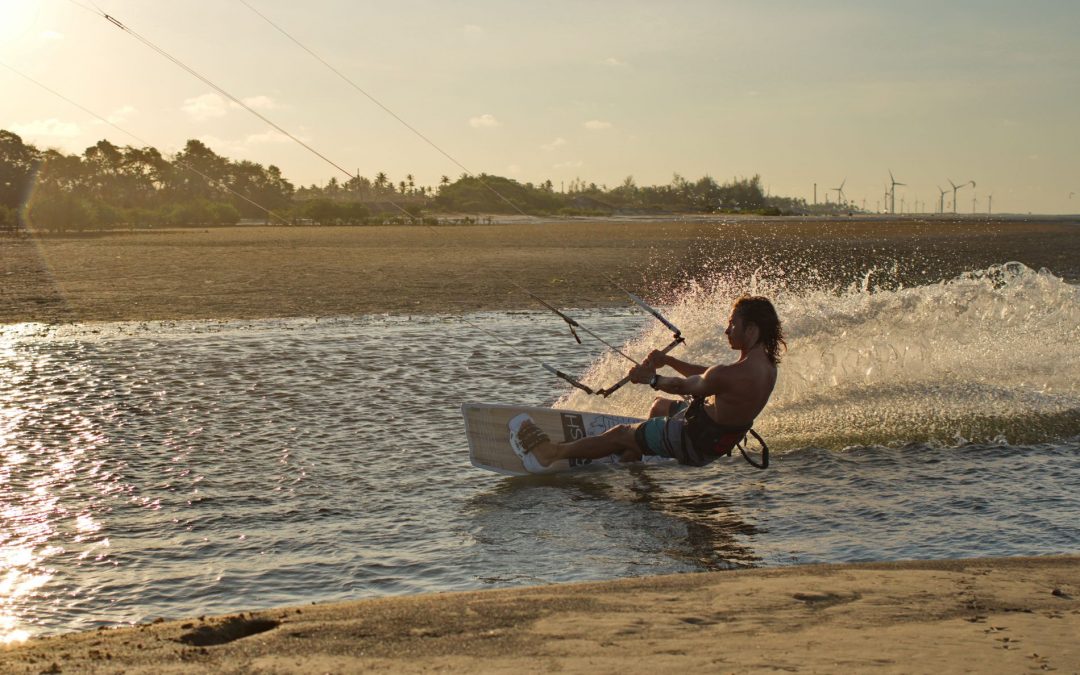
BIG SMILE
The ultimate target in the development and construction of a kiteboard is to provide the user a sport equipment that is adapted for the rider’s skill and style. A beginner needs a completely different kiteboard than an experienced freestyler.
Therefore it is essential to have a clear classification of characteristics. Woodboard divides the kiteboard range in the following categories:
Beginner
Freeride
Freestyle / Wakestyle
Big Air
Strapless Wave
Strapless Freestyle
With knowhow, experience and feedback provided by the team riders the designing engineer knows exactly which features and characteristics are necessary for each category.
Ultimately, all this work is done to satisfy the rider’s demands on a kiteboard. Woodboard not only wants to fulfil those demands. We want to get ahead of these needs to generate a “big smile on the rider’s face”.
This is only possible with years of experience in board shaping and a solid background in engineering.
SCRIBBLE
Every new shape starts with a hand drawn scribble. The designing engineer drafts his vision on a piece of paper. With his personal knowhow as well as the team riders’ information, all the basic characteristics of the boards are already shown in the scribble.
DIGITAL PROTOTYPE
Next step is to build a digital prototype with a full 3D construction software. That way it is possible to calculate and simulate different materials, flexural behaviour, torsional stiffness and impulse response. If the result is coherent, the digital prototype is ready for the next step.
HYDRODYNAMIC DETAILS
It took a couple of years to collect enough data, but now Woodboard is able to simulate nearly every riding situation with a software. Gliding, takeoff and landing will be simulated repeatedly until we achieve the perfect outline, flex, channel and fin positon. Every new kiteboard contributes a lot of new data to our simulation software. That way, the simulations continuously become more accurate.
CONSTRUCTION
When the digital prototype is finished and optimized it includes all necessary details for production like outline, surface geometry, channels, rail, material, thickness, resilience and flexibility.
The mould for the core, the outline and the shape of the finished board are derived by the constructional drawing.
THE MOULD
The constructional drawing provides the reference to shape the aluminium mould of the board. It consists of an upper and a lower part. Together it forms an airtight room which will later become the shape of the finished kiteboard.
THE PROCESS OF PRESSING
In this mould all components are pressed with glue for 15 minutes at 60°C and with 60 tons of pressing force. Before opening the press, the kiteboard needs to be cooled down to room temperature to prevent uncontrolled deflection. The tips would cool down much faster than the core area which can result in an unwanted outcome. This process needs a lot of experience and, in the end, plays a significant role regarding the quality of the product.
THE FINISHED PRODUCT
At the end we get a sport equipment that depends on the know how and quality awareness of all workers involved in the process. Engineers, material supplieres and manufacturers create the finest rides and a lot of fun.
A lot of kitesurfers have a hard time to choose: Which kiteboard is the best for me? We want to give you some tips how to choose the right one.
FIELD OF APPLICATION
First of all you can decide between a twintip (bidirectional) and a directional kiteboard. Twintips have symmetrical tips, allowing you to ride in both directions. Directional kiteboards are meant to be ridden in only one direction, usually strapless, without pads & straps. This allows you to keep your stance in the riding direction.
Within the twintip range you can choose between:
Teaching
Beginner
Freeride
Freestyle / Wakestyle
Big Air
Low End
KITEBOARDS FOR TEACHING
Kiteboards for teaching kiteboarding are usually a bit bigger than the average kiteboard. During their first times on a kiteboard, beginners like to step on it actively, therefore a bigger area offers more resistance and stability. But pretty fast they will learn to start dynamically and adapt to a smaller kiteboard. Boards bigger than 145 cm are usually meant for kiteschools only. Private riders can normally get a smaller board right away. Once you are able start and ride consistently, those large kiteboards bring some disadvantages, like the lack of mobility.
Good kiteboards for teaching are the Duotone Spike (ca. 700€) and the Woodboard Beam (ca. 400 €).
BEGINNER KITEBOARDS
A kiteboard for an inexperienced user should not be flat at the bottom running base. It should have a single concave at least, which will significantly help to go upwind. With a flat running base a kiteboard gets stuck on the water easily. For the rider it feels like the board is turning really bad and slowing down constantly; therefore, it is quite exhausting to ride. A beginner usually does not profit from channels, a single concave is more than enough.
Proven kiteboards for beginner are the Duotone Gonzales (ca. 500€) and the Woodboard Beam (ca. 400€).
FREERIDE KITEBOARDS
A freeride kiteboard should have channels on the running base. Those channels are profiles on the bottom of the board to direct the water. Companies in the industry are working on different concepts. Some channels are parallel to the axis of the kiteboard, this helps the rider to keep a straight direction, even at high speed. Others are working on constricting channels that speed up the water under the kiteboard, resulting in more uplift force. The kiteboard has a loose feeling and a good low end. This concept follows Bernoulli´s law, better known as the Venturi effect. Good examples for kiteboards using the Venturi Effect are the Woodboard Chame and the Woodboard CRBN.
Nice Freeride Boards on the market are the Duotone Select (ca. 680€), the Woodboard Chame (ca. 500€) and the Woodboard CRBN (ca. 550€). Both Woodboards are equipped with venturi channels.
FREESTYLE- UND WAKESTYLE KITEBOARDS
Feestyle and wakestyle boards need to have three main characteristics. The kite should stay deep in the wind window and the board should deliver a strong pop during the takeoff. Unhooked landings are generally quite fast; therefore, the board needs to keep direction and perform well at high speed.
More rocker generates resistance in the water, which prevents the kite from flying to the edge of the wind window. A strong pop is provided by the right construction and the chosen materials. Accurately placed channels help to keep resistance while taking off, even at high speed and with a lot of power. A double concave delivers smooth landings.
Good freestyle boards on the kitesurf market are the Duotone Team Series (ca. 800€) and the Woodboard Trash (ca. 550€).
BIG AIR KITEBOARDS
For real Big Air enthusiasts there are special Big Air boards. Once a rider reaches the 15-meter mark, it is useful to get a Big Air kiteboard. Woodboard offers a kiteboard strictly designed for Big Air. At first sight the big keel on the bottom is visible. This keel offers extremely soft and controlled landings, even at high speed. Deep channels in all areas of the board allow to hold the edge to a maximum. This results in a strong line tension and that’s exactly how you get all the energy to jump really high. Classic “Load & Pop” seems difficult with this kiteboard, as it is designed for massive winds and big kickers. An average rider might struggle, but Big Air riders are reporting up to 20% more height with the same technique.
Good Big Air Boards are the Carved Imperator (ca. 1250€) and the Woodboard Basalt BIG AIR (ca. 750€)
LIGHT WIND KITEBOARDS
There are two different concepts to enhance the low end ability of a kiteboard. We can increase the area to create more floatation. Or we try to speed up the water under the kiteboard to generate more uplift force.
Bigger Boards have a bigger area to create uplift force. Therefore the area enables the rider to start gliding faster. Like the “Doors” back in the days. But those big kiteboards have a significant disadvantage: The bigger the board gets, the flatter and higher it sits on the water surface. That small angle to the surface reduces the uplift force a bit. In the end the advantage of the bigger area gets evened out by the poor angle to the surface. Leaving a couple of disadvantages for the big kiteboards, like a lot of spray and a hard ride on the chop.
Woodboard concentrates a lot on the idea to create a high uplift force by speeding up the water under the kiteboard. This happens by constricting channels, which generate a faster water flow. This concept is based on Bernoulli’s Law and the Venturi Effect.
The german kite magazine made a light wind test with our first kiteboard with venturi channels. The Woodboard Beam in size 135 cm won the race against many way bigger kiteboards.
We use cookies to optimize our website and our service to give you the best experience. Functional cookies are necessary for the proper function of our website, therefore can´t be disabled. Please give us your consent for the other cookies too, you will help us to improve our services by collecting anonymous analytics data.
Functional cookies
Always active
The technical storage or access is strictly necessary for the legitimate purpose of enabling the use of a specific service explicitly requested by the subscriber or user, or for the sole purpose of carrying out the transmission of a communication over an electronic communications network.
Preferences
The technical storage or access is necessary for the legitimate purpose of storing preferences that are not requested by the subscriber or user.
Statistics
The technical storage or access that is used exclusively for statistical purposes.The technical storage or access that is used exclusively for anonymous statistical purposes. Without a subpoena, voluntary compliance on the part of your Internet Service Provider, or additional records from a third party, information stored or retrieved for this purpose alone cannot usually be used to identify you.
Marketing
The technical storage or access is required to create user profiles to send advertising, or to track the user on a website or across several websites for similar marketing purposes.